Hearing Wild Messages : How to Understand Any Animal That Crosses Your Path
By Lola Archer Pickett ·
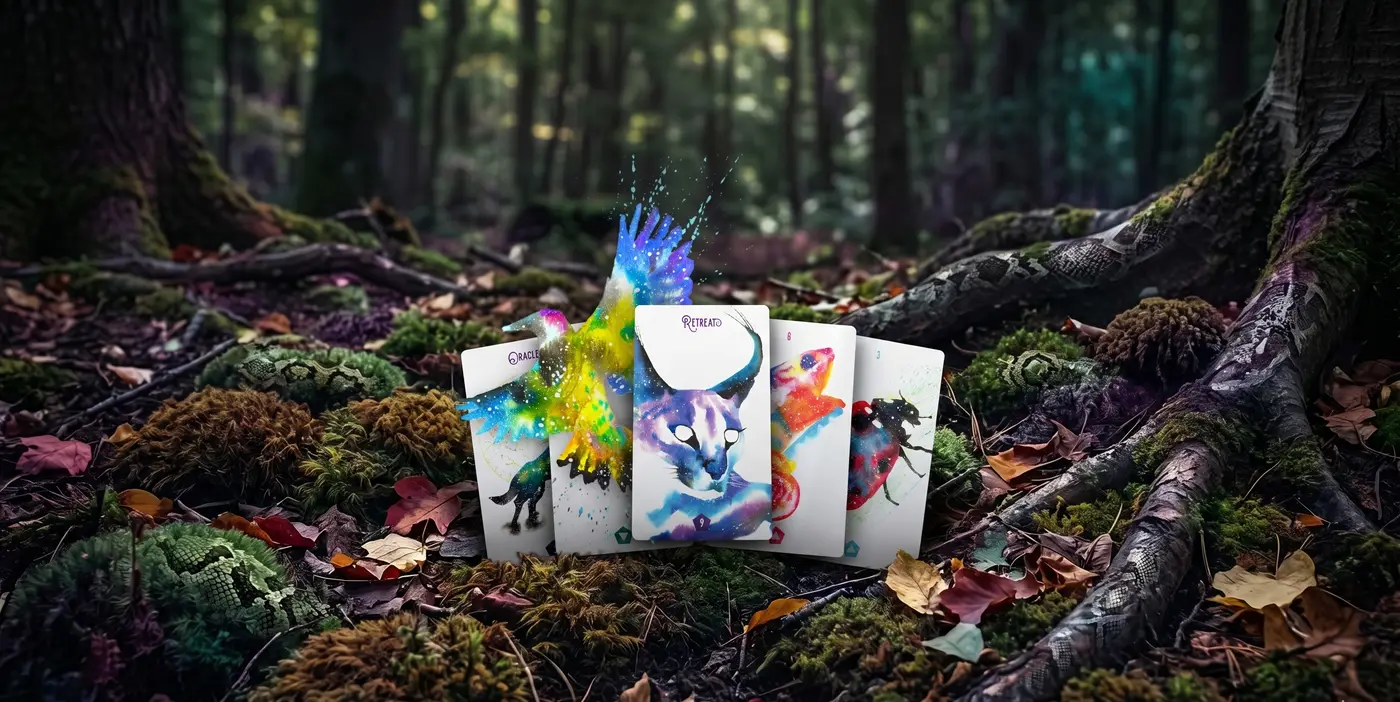
Wild Messengers aren’t limited to the 78 animals and two Wild Cards in this Tarot deck. You can learn to see, interpret, and understand messages from any animal you encounter in your daily life: a raven on a fence post, a cricket in the corner of your room, a grey fox at dusk… Instead of only referencing the internet (à la googling “what’s the meaning of [animal]”), you can also look to the outer web of life for personal and collective insights.
Over time, the practices below will help you build a deep sense of belonging in the world. Allowing nature to “speak” to you also gives you a sense of ancient rootedness. All of our indigenous ancestors, regardless of where or when they lived, looked to the world around them for critical guidance and spiritual insight. Receiving messages from the wild was an essential survival mechanism for navigating daily life.
For years, animal messages kept showing up for me at exactly the moments I needed them. I started listening, then writing down what they had to say, and sharing with close friends and family what I was learning. The intuitive connections I made with what each animal represented in that moment and what it had to share would often floor the person I shared it with.
Eventually, I offered more than 2,100 intuitive Animal Messenger readings and then ultimately, decided to empower you to connect with the animals anytime.
Beyond working with the Wild Messengers Alchemical Tarot, this page shares more about how I learned to hear and understand all the Wild Messengers of our world.
A few simple steps to understand messages from the wild
Every encounter speaks in three ways: through the animal itself (its nature, markings, and cycles), through what it was ~ or wasn’t ~ doing when you met, and through what was happening in your life at that moment. The steps below help you listen to all three.
First, pay attention
Begin to notice the birds, reptiles, mammals, insects, and water beings who cross your path. As you become familiar with them over time, you’ll begin to note behaviors or circumstances that are out of the ordinary or remarkable, such as a hawk flying low in front of you while you’re driving, or a group of crows cawing noisily where you usually only see one or two silent ones. You might also see animals showing up repeatedly as images on people’s clothing, in advertising, or otherwise represented in 2D.
When an animal catches your attention, pause and stay with it. Take a breath. Notice your body’s response before your mind starts hunting for meanings.
Anytime you see an animal calling for your attention, it has a message for you. And though it might seem superstitious or egotistical to think that it could possibly be speaking specifically and directly to you, what if it is and you choose not to listen?
Just like your own intuition, a friendship, or any other relationship, when you don’t listen or acknowledge the other party, the connection gradually fades away. So each time you act as if nature is talking to you, it strengthens your connection and activates even more “conversations” between you and the wild world.
I recommend keeping notes about the animals you encounter in a small journal or even on your phone. This helps you see patterns over time and remember the circumstances surrounding each significant-feeling encounter.
Whenever you feel an animal has a message for you, note the following as soon as possible:
- Which animal/being(s) did you see?
- Where were you, and what time of day was it?
- What were you thinking about or doing when you saw it/them?
- If it was a 3D encounter, what was the animal doing (or not doing) that caught your attention? Was it alone or with others? Did it hold your gaze or move on?
- What was the animal’s condition (healthy, unwell, injured, dead)?
- Any immediate intuitive hits about what it was trying to share with you?
Pay special attention to what you were thinking, doing, or deciding just before it appeared. Often the encounter answers a question you didn’t know you were asking.
Next, get familiar with the animal(s)
If you don’t know about that animal’s natural, wild behaviors, traits, and makeup, then it’s time to put on a wildlife researcher hat. The animal’s undomesticated behavior are where much of the medicine lives. Our Resources page lists books and websites that offer reliable wildlife information.
Explore the following:
One: What are the animal’s significant colorings or markings?
The colors or markings can be quite significant to the meaning of the message. What do those colors signify from an energy perspective? These colors may indicate areas in your body and/or life that need extra focus, love, and attention right now.
You might associate browns, blacks, grays, and earth tones with the Earth element, whereas yellows, reds, and oranges could be fiery colors. If you’re familiar with the chakra system, you can also draw parallels between the animal’s coloring and the chakras.
For example, let’s say you came across a Red-Breasted Robin who was quite obviously calling for you to notice it.
Robins are black with a red chest and a bright yellow beak. If I were guiding you personally, I might interpret the colors as follows. I’d look at the yellow beak as a metaphor for the role of vocal expression (the beak is the vehicle for expression) to support and amplify your personal power and solidify your sense of self (third chakra = yellow).
The flame of red over the Robin’s breast indicates a strong connection between the heart (where the red occurs) and being grounded (root chakra = red). So if your heart is hurting, connection with the Earth may help soothe you.
Two: What are some of their life cycles?
Each animal’s various life cycles can be a carrier of messages, too! Research life span, gestation periods, time to maturity, timing and duration of seasonal migrations, nocturnal/diurnal/crepuscular activity periods, and so on. These will help you clarify how your own rhythms and cycles can be informed by theirs.
One sample life cycle story could be built around the animal’s gestational period (and typical number of offspring), which often points to how long it takes for you to give birth to new ideas or projects (and how many you should be working on simultaneously).
These numbers may also have numerological significance for you, so numerology and sacred geometry often come into play.
For example, Rabbits have numerous offspring, and the babies gestate in a span of just 28 days. VERY quickly! (This is why rabbits are so prolific!)
What could this look like if a Rabbit hopped across your path as a messenger?
The message could be that you’re in a fertile cycle of your life at the moment, and it’s alright to take on more than one project or idea at a time. These ideas might “mature” relatively quickly, perhaps even coming to completion within one moon cycle. But they will probably be smaller in nature (vs. one huge idea that will take a long time to develop), and then it’s on to the next thing. Don’t feel badly if you’re trying many new things right now.
Frogs also have numerous offspring, but the maturation process is quite different. They go through a complete metamorphosis. So if Frog hopped in as a messenger, you may be in the process of developing some creative ideas, but don’t get attached to their initial appearance. They will likely change shape as you evolve, emerging nearly unidentifiable from where they began.
On the other hand, Big Cats usually have only one or two babies that survive to maturity. Each cub takes two years to reach full maturity, and when they are grown, they are giant. If a Big Cat made an appearance to you, your work may take the form of only one or two LARGE projects that take a significant amount of time to be ready for the world.
This is only one of the many life cycles each animal has, so you can see right away how deep the possible messages can go.
Three: How do they hunt?
This is an important factor to consider when it comes to wild messages about your work or career. How an animal hunts (and what it eats) can offer extremely relevant insight into how you can operate your business or approach your career.
Questions to consider include:
- Is the animal you encountered a grazer or a hunter?
- What size prey do they eat, and how often?
- How do they go about hunting? In groups? Silently? At night or in the day? Are they ambush hunters?
- Are they also a prey animal?
For example, Foxes use a behavior called “charming” to hunt. Sometimes they will dance, and leap, and jump, and twirl in front of their prey. This charms, disarms, and distracts the prey, allowing the fox to get closer and closer, until… SNAP! Fox has dinner.
People sometimes label or judge this behavior as tricky or manipulative. However, if you want to learn from a Fox messenger, it’s a strong indication that you need more PLAY in your work.
The more fun you have, the more people will be drawn closer and closer into your world, and then, SNAP! You can offer them the depth of your Sacred Work, which might have intimidated them away without a playful entry point.
Four: What other animals (if any) are included in its food chain?
This might help you understand what type of clients or people will resonate best with you, and the best structure for your offerings, projects, and relationships.
For example, Elk are grazers. They move in herds and munch on grasses and plants, helping turn the soil in meadows and creating fertility for the coming season. If you are in a client-facing role, the message could be that you want to create offerings or work in an environment where you have a constant source of clientele: perhaps people who don’t invest a lot as individuals, but as a collective can offer a steady and robust income.
Big Cats, on the other hand, will eat just about anything, but they prefer larger prey and will sometimes go weeks between meals. This could indicate a resonance with creating larger offerings or going after bigger deals that allow you to have space between “meals,” like running a launch once or twice a year for a larger program, with smaller offerings in between.
Five: How, when, how often, and with whom does this animal mate?
This has obvious implications for your intimate relationships, but it can also be applied to other important partnerships in your life, such as friendships, joint ventures, managers or bosses, or your own team at work.
- Does the animal mate for life or more short-term?
- Is it generally monogamous?
- What are its behaviors to attract a partner?
- How often does it have sex (and in what style)?
- Does it do so purely for breeding or also for pleasure?
Now, look at the status of your most important relationships. Are there any intuitive parallels you can draw between the animal’s mating preferences and what’s unfolding in your friendships, partnerships, or career relationships? Does some of your (or their) behavior need to shift? Are your relationship dynamics healthy for you?
Finally, ask it directly
Close your eyes and ask, “What do you have to show me?” Write down whatever comes, without editing.
If the animal is one of the Messengers, read its card in your guidebook. If it isn’t, find the Messenger that feels closest in spirit and read that one.
And let it be yours. No resource, including my work, can ever outrank your own inner knowing. If the meaning that rises for you differs from other interpretations, trust it.
Now, rinse and repeat!
Over time, you’ll have less research to do as you become familiar with the animals you run into most often. And a special hint: the more triggering, bothersome, or distasteful your findings are, the more likely they are to have some sort of resonance or meaning for you. Dig deeper and see why you are finding the information so off-putting.
When an animal keeps showing up, nature is turning up the volume on what it’s trying to communicate with you. Your notes will show you patterns: the date, the animal, and what was happening in your life. Patterns often become clear over weeks, not minutes.
When the encounter is hard
Sometimes, your encounter may be with an animal in distress or an animal that has passed away. These experiences can be difficult, not only because most of us would never want to see another being in pain or suffering, but because it can bring up fears around our own mortality.
You might wonder if it’s an omen or warning of some kind.
But, in my belief system, I do not immediately associate illness, disease, injury, or death as negative messengers. No matter what the root cause, these are states that occur naturally to all beings with life force.
The message may simply be to remain present, to notice and acknowledge what is going well in your life or to take care of those you love (starting with yourself). It’s often easier to empathize with a creature that’s suffering and forget that you, too, are carrying pain. You, too, are deserving of kindness. You, too, are someone that matters.
Perhaps it’s an invitation to be honest with yourself about what isn’t working well right now. Or to clean up any messes you’ve left behind. Or to return to habits and behaviors you know are supportive but have been neglecting.
It may also be a message that something is coming to a close and making space for new life to blossom. With any death, there is also rebirth.
Perhaps consult the Butterfly Card, Rebirth (Number 13) if you have encountered a being who has passed on.
Respect the wild
Please remember to observe the world’s wild ones from a distance, never feed or chase wildlife, and leave the animal as you found it ~ unless you need to call in professional support, such as someone to relocate a dangerous animal or help with an injury.
Journal prompts
- What animal(s) crossed my path this week?
- What have I been working on, navigating, or feeling?
- What does this animal do well that I’m being asked to learn?
- If this animal could speak one sentence to me, what would it say? (write this answer intuitively, without strategizing what it “should” sound like.)
As you practice observing your local animals, you’ll develop a dynamic and in-depth vocabulary of what each interaction means for you.
xo,

More from the Journal
- The Alchemy of Awakening: The Seven Phases of Transformation Alchemy is a map for personal transformation. Learn the seven alchemical phases, how they spiral through a lifetime, and how each Major Arcana card in the Wild Messengers deck carries one.
- Across the Veil: A Samhain Tarot Spread for Letting Go A six-card Samhain tarot spread for letting go, honoring the harvest, and receiving ancestral wisdom while the veil is thin. Includes journal prompts.